Agent Settings
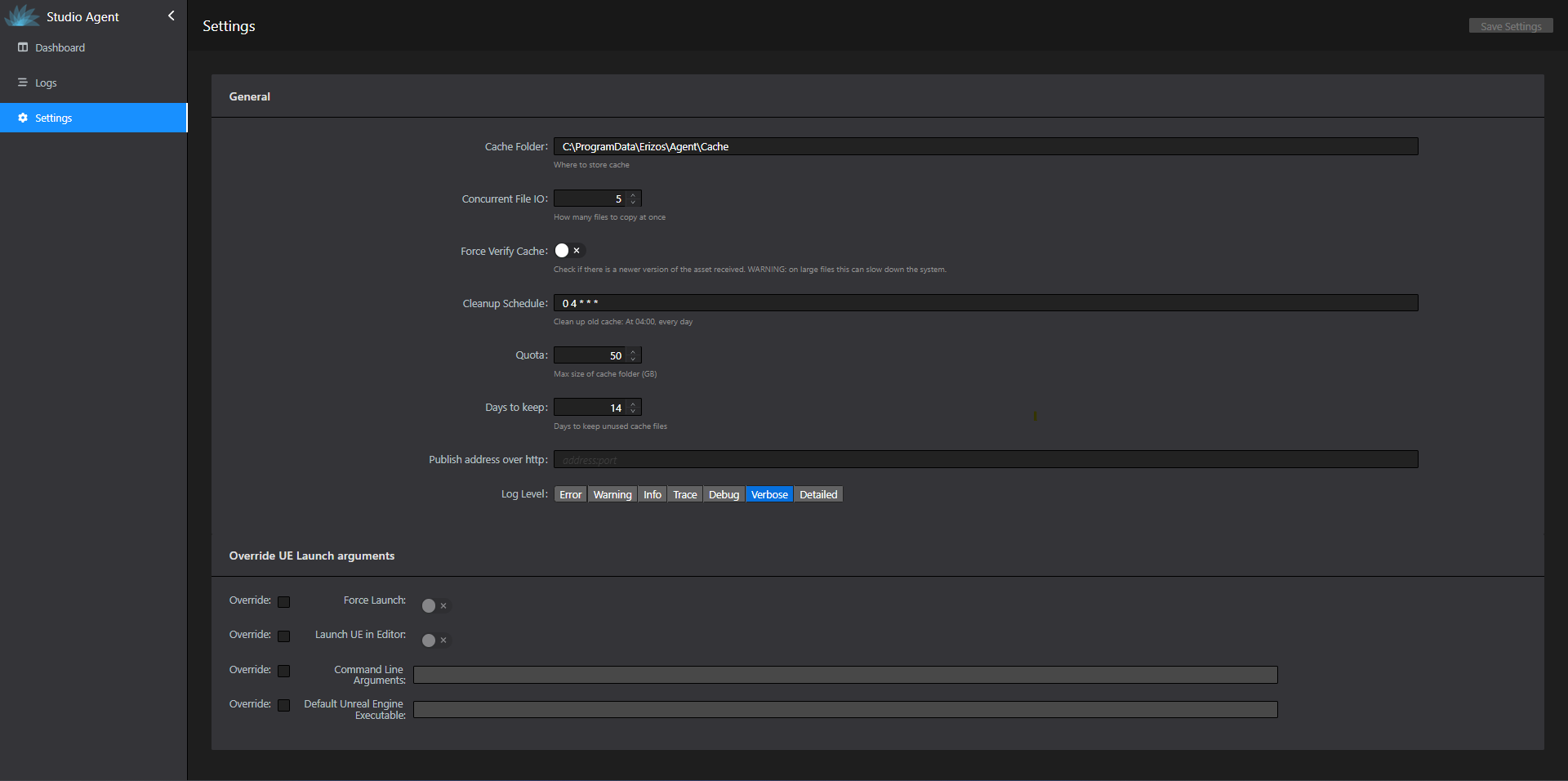
By navigating to “http://[RENDER ENGINE IP]:5510” in your browser of choice and choosing the Settings tab you will have access to the following settings for Agent:
- Server Tag: a short label for this Agent, shown in the browser title bar. It makes it easier to tell several Agents apart.
- Cache Folder: You can select where Agent will manage the cache folder by filling a path to a folder in your file system. The default is
C:\ProgramData\Erizos\Agent\Cache. - Concurrent File IO: How many files to copy at once, from 1 to 20. The default is 5.
- Force Verify Cache: Check if there is a newer version of the asset received. WARNING: on large files this can slow down the system. Off by default.
-
Cleanup Schedule: when the Agent cleans old files out of the cache folder, written as a cron expression. The default is
0 4 * * *, which is 04:00 every day. A plain-language description of the expression you type is shown under the field.Info
The clean up time is written in cron string format, for more information cron string
Note
If the Cleanup Schedule is left empty, the cleanup only runs when the Agent starts.
-
Quota: the maximum size of the cache folder in GB. The default is 150 GB, minimum 1.
- Days to keep: how many days Agent will keep cached files that are not used, from 1 to 365. The default is 14. The count is taken from the last time a file was used, not from when it was downloaded, and a file is only removed once it has been unused for more than that many whole days.
- Publish address over http: for files that are served over http, for example,
http://...instead ofC:\.... Enter it asaddress:port; if you leave the port out the Agent's own port is used, and if you leave the field emptylocalhostis used. The address is used to build the//<address>/api/cache/raw/<file>URLs of HTTP-published assets.
This setting is most used when using Singular as the render engine - Log Level: Select the Log Level for the Agent.
-
Copy Method: how the Agent copies files into the cache - Native File Copy (the default) or Robocopy.
Warning
Robocopy is Windows-only, and it changes more than the copy command. With Robocopy the Agent does not report copy progress, a running copy cannot be cancelled, the Concurrent File IO setting is ignored, and the folders
Saved,IntermediateandDerivedDataCacheare always excluded from the copy. The per-AgentERIZOS_DYNAMICfile selection is not applied either, which is what the hint under the field refers to. Switching Copy Method also changes how the Agent fingerprints a folder, so everything already cached is re-copied the first time. -
Send Progress Updates: whether the Agent reports caching progress back to Studio - Yes (the default) or No.
- Enable Stream Deck: opens a websocket so a connected Stream Deck device can drive Erizos Studio. Off by default.
- Stream Deck Port: the port used for the Stream Deck websocket, from 1024 to 65535. The default is 5800. It can only be edited while Enable Stream Deck is on.
How the cache cleanup works
The cleanup runs when the Agent starts and then on the Cleanup Schedule, in this order:
- Records whose file is missing from disk are dropped, files in the cache folder that the Agent has no record of are deleted, and any file whose size on disk does not match the record is discarded as incomplete.
- Cached files that have not been used for more than Days to keep days are deleted.
- Only then, if the cache folder is still at or over the Quota, files are deleted until it is back down to about 80 % of the quota. Anything used within the last 12 hours is left alone.
Note
The Quota is only applied by this cleanup. It is not checked while assets are being cached, so the cache folder can go over the quota between two cleanup runs.
Override UE Launch arguments
You can also override default settings such as overriding the default UE Executable file (useful when you are using a custom build of Unreal Engine), setting up Command line Arguments, and Launching UE in the Editor.
Each row has an Override: checkbox. While it is unticked the field is disabled and the Agent uses the value that comes from Studio; tick it to set a value on this Agent instead.
- Force UE Launch: normally the Agent will not start Unreal Engine if an
UnrealEditororUE4Editorprocess is already running on the machine. Turn this on to launch anyway. - Launch UE in Editor: on adds
-AutoStartPIEto the launch, off adds-Game. - UE Command Line Arguments: You can send command to UE by passing arguments through Agent. The value is split on spaces and appended to the launch arguments.
- Default UE Executable: If you are using a custom build Unreal Editor, you can override the default UE executable by providing the path where the Engine folder of the Custom Build is located. It is only used as a fallback - the Agent first tries to resolve the engine from the project's
EngineAssociationthrough the registry, Pixotope and Aximmetry. - nDisplay - Node Name: the name of this machine's node in the project's nDisplay configuration. Tick the nDisplay checkbox to enable the field. When a node name is set and found, the Agent launches Unreal Engine with the window position and size of that node (or full screen, if the node is configured that way). If the name is not found, the Agent logs Failed to find node '…' in nDisplay configuration and launches without the nDisplay arguments.
- MediaHub: the MediaHub address this Agent should use, instead of the one it would take from Studio.
| Override | Property | Default Value |
|---|---|---|
| False | Force UE Launch | False |
| False | Launch UE in Editor | False |
| False | UE Command Line Arguments | Empty |
| False | Default UE Executable | Empty |
| False | nDisplay Node Name | Empty |
| False | MediaHub | Empty |
Note
You can learn more about Unreal Engine Command-Line Arguments in this link.